





-
2-5 Players
-
60-90 Minutes
-
Ages 12+

Villain Inc.
-
Strategy
-
Complexity: 3.0/5
-
Ready To Publish
Mechanics
Interrupts • Area Majority / Influence • Worker Placement
Game Overview
Core Concept
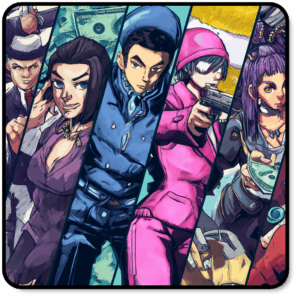
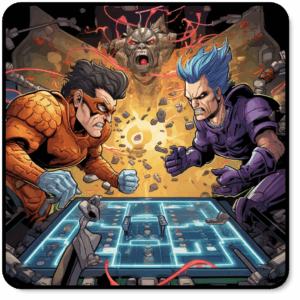
Villain Inc. is a 2–5 player competitive strategy game where players run nefarious corporations in a shadowy world of villainy and manipulation. Your mission: accumulate Influence while keeping your Exposure in check. Push too far, too fast, and the heroes will notice. Play it safe, and your rivals will surpass you. Once any player’s Influence and Exposure values cross on the track, the game ends immediately. The player with the highest Influence minus Exposure wins. Timing is everything—and someone else’s downfall might just be your opportunity.
Key Systems:
Action Selection with Consequences
Each turn, players choose one of five core actions—each advancing their corporate agenda at a cost:
- Upgrade: Improve your company board to gain better income, capacity, and efficiency. Each upgrade earns Influence—but increases your Exposure.
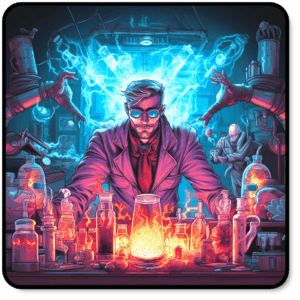
- Experiment: Spend coins to roll custom dice and generate result cubes. These are used to create Supervillains with unique powers. Like upgrades, experimenting adds Exposure.
- Deploy: Send henchmen to one of nine tiered Locations. Control grants passive bonuses; total control yields coin and Influence. Deploying adds even more Exposure.
- Scheme: Play cards that manipulate rivals or boost your plans—but drawing them costs Influence.
- Lay Low: Reduce your Exposure by 2 and sit this turn out. Sometimes, silence is your best defense.
Exposure vs. Influence
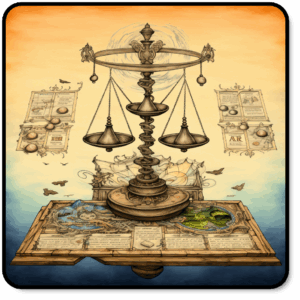
Players must constantly weigh short-term gains against long-term risks. Spending Influence gets you powerful effects, but leaves you vulnerable. Exposure attracts unwanted attention—and at specific thresholds, Superhero Disruptor Events are triggered, creating randomized setbacks tied to your overreach.
Supervillain Engine-Building
Use your Experiment Results to create Supervillains, each providing new passive or triggered abilities. Choose carefully—your villain roster determines your strategic direction and interaction with opponents. Some abilities support your economic engine; others apply pressure to the competition.
Territory Control with Escalation
Nine shared board Locations offer escalating benefits based on presence, majority, and dominance. With only a few henchmen, players must prioritize key territories or risk losing them to better-positioned rivals. Some Locations reduce the cost of experimentation; others improve resource exchange rates or unlock Influence bonuses.
Design Principles
Tension Through Dual Metrics
The crossing of Influence and Exposure is both the ticking clock and the win trigger. Every turn nudges both values closer. Players must read the table: Is someone about to end the game? Should you force the pace, or slow it down? Timing your exit is as crucial as your ascent.
Asymmetric Paths to Power
There’s no “right” way to become the ultimate villain. Specialize in upgrades, control key Locations, amass a Supervillain team, or manipulate through Schemes—every approach is viable if you manage your Exposure.
Measured Interaction
Scheme cards and certain Supervillain abilities create player conflict without overwhelming the game’s strategic core. Players can mess with each other—but only when the timing is right, and the cost is worth it.
Endgame Structure
Instant Trigger
The moment any player’s Influence and Exposure markers cross, the game ends immediately—no final round. Every other player calculates their Influence minus Exposure, and the highest score wins.
Strategic Implications
Players must anticipate not only their own threshold but their rivals’. Triggering the end too early could hand the game to a better-balanced opponent. Holding back too long might let others sneak past. The tension in Villain Inc. is ever-present—and when it ends, it ends fast.
Future Expansion Ideas
- Unique Corporate Factions: Starting abilities and passive effects to deepen asymmetric strategies.
- Advanced Scheme Decks: Themed decks for different villain archetypes—corporate, arcane, political, etc.
- Hero Interference System: An evolving threat board where collective Exposure triggers global disruptions.