














-
1-5 Players
-
30-45 Minutes
-
Ages 12+

Alien Invasion
-
Complexity: 2.5/5
-
Cooperative
-
In Development
Mechanics
MENACE Inspired • Deck Building / Destruction • Tech Tree
Game Overview
Players fend off an evolving alien threat in Alien Invasion, a cooperative strategy game with a unique adaptive AI which learns from the players. With its evolving threat model, deck tension, and strategic tech upgrades, it invites players to think not just about what they can do but also what they shouldn’t do to teach the aliens to expect.
Core Concept:
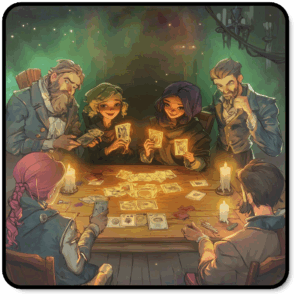
- Cooperative strategy game for 1–5 players with individual decks, evolving tech trees, and shared goals.
- Players are Earth’s last line of defense against a learning alien threat.
- The alien AI adapts using a simplified machine learning model inspired by MENACE (Matchbox Educable Noughts and Crosses Engine).
- Every decision teaches the aliens how to better counter the players — no two games are alike.
Key Systems:
- MENACE-Inspired AI:
- Alien decisions are driven by a simple reinforcement-learning system. Early behaviors are random but quickly adapt based on prior outcomes.
- Deck-Building and Deck-Destruction:
- Players strengthen their capabilities through deck-building, but many powerful actions destroy or weaken cards, forcing long-term planning.
- Tech Tree Advancement:
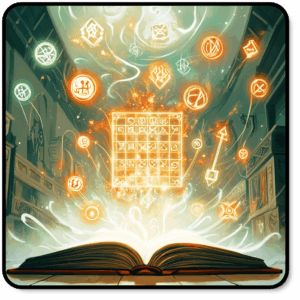
- Each player (or the team) develops technologies from a branching tree, unlocking new tactics, global bonuses, and alien counters. Different trees support different playstyles (e.g., surveillance, drone strikes, diplomacy).
- Adaptive Alien Behavior:
- Alien actions aren’t pre-scripted — they are selected via learned patterns based on past success, encouraging players to diversify and mislead the AI.
- Scenario-Based Objectives:
- Modular missions with escalating win/loss conditions. Players must complete tasks (e.g., defend cities, uncover alien plans, disrupt evolution cycles) before being overwhelmed.
- Global Threat Track:
- Tracks alien knowledge and influence. As it rises, aliens unlock new powers or behaviors (analogous to an evolving “level-up” bar for the enemy).
Design Principles:
- Asymmetric Growth:
- Players advance via tech and deck upgrades, while aliens grow through learned behavior and global escalations.
- Tension Curve:
- Early game may feel “manageable,” but alien adaptation ramps unpredictably, requiring players to pivot strategies.
- Minimal AI Overhead:
- MENACE-style engine means alien decision logic is transparent and learnable, but still surprising.
- Emergent Narrative:
- Scenarios evolve differently each play, resulting in story-driven sessions with real consequences from player choices.
Endgame Structure:
- When the Global Threat Track hits its final threshold, the aliens deploy a final evolved protocol — a boss-level adversary, global lockdown, or planetary-scale event.
- Players must complete a final coordinated objective (e.g., disable the mothership, shut down alien mind-networks, etc.) using all learned upgrades and surviving cards.
Next Focus Areas:
- Finalize structure of MENACE AI interactions (board state encoding, feedback loop).
- Design and balance player Tech Trees (number of paths, effects, synergies).
- Create Deck Pools for each role (and how destruction reshapes them).
- Develop Scenario Framework (difficulty tiers, mission variants, alien traits).
- Test for emergent AI exploits or soft locks.
Summary:
Alien Invasion combines co-op strategy with adaptive AI in a game where the enemy learns from you. With its evolving threat model, deck tension, and strategic tech upgrades, it invites players to think not just about what they can do—but what they shouldn’t teach the aliens to expect.